
Choosing Possibility When the Odds Are Against You

On living with uncertainty, trusting yourself, navigating the cost of cancer, and holding onto hope when statistics tell only part of the story.
When you're living with a chronic or "incurable" diagnosis, you quickly become familiar with the language of probability.
Statistics. Prognosis. Median survival. Treatment response. Disease progression.
Numbers that attempt to explain what might happen next.
And while I understand the importance of science, research, and evidence-based medicine, I've also come to understand something else:
Statistics describe populations. They don't tell the complete story of an individual.
I've spent years navigating a diagnosis that has challenged nearly everything I thought I understood about health, healing, and the human body.
I've listened to oncologists explain treatment options and probabilities. I've explored integrative approaches, sought additional perspectives, studied emerging research, and invested an extraordinary amount of time, energy, and money into supporting my health.
And somewhere along the way, I've learned that living with uncertainty requires more than simply following instructions.
It requires discernment.
It requires courage.
And sometimes, it requires being willing to explore possibilities that don't come with guarantees.
The Space Between Evidence and Possibility
One of the more challenging aspects of navigating cancer has been learning to exist between two worlds.
Conventional medicine, with its clinical trials, established treatment protocols, and measurable outcomes.
And integrative care, where nutrition, lifestyle, complementary therapies, and other approaches are explored for their potential to support the body and improve quality of life.
These worlds are sometimes presented as though they are in opposition.
But I don't believe they have to be.
I am profoundly grateful for modern medicine and the treatments that have helped manage my cancer. I also believe there is value in looking at health through a broader lens.
That doesn't mean every alternative approach works. It doesn't mean every promising theory translates into a meaningful clinical outcome. And it certainly doesn't mean something is effective simply because someone believes in it.
But I also don't believe that uncertainty automatically means something has no value.
There is a difference between something being proven ineffective and something not yet having sufficient evidence to establish its effectiveness.
That distinction matters to me.
It doesn't eliminate the need for critical thinking or careful evaluation. If anything, it makes those things more important.
Because when you're the person living with the diagnosis, you're not simply evaluating theories.
You're making decisions about your life.
The Invisible Cost of Exploring Every Avenue
Something I don't think gets talked about enough is the enormous responsibility that can come with becoming an active participant in your own care.
People often say, "Be your own advocate."
And I agree.
But what does that actually look like?
For me, it has meant countless hours researching, asking questions, reviewing information, connecting with practitioners, and trying to understand an increasingly complicated medical landscape.
It has meant managing appointments, treatment schedules, side effects, finances, and the emotional weight of decisions that don't always have clear answers.
It has meant investing in approaches that may help, while accepting that their benefits aren't always measurable or guaranteed.
And it has been exhausting.
Because when you're exploring options outside the standard treatment pathway, there often isn't one person coordinating everything.
You're the one connecting the dots.
You're the one weighing the potential benefits against the risks, costs, and unknowns.
You're the one trying to decide what deserves your limited resources.
And those resources aren't infinite.
Time matters. Money matters. Energy matters.
Especially when you're living with a serious illness.
I've come to recognize that pursuing every possible intervention isn't necessarily the same as making the best decision.
Sometimes discernment means exploring something new.
And sometimes it means deciding that something is no longer worth the investment.
Being proactive about your health also means giving yourself permission to say no.
The Financial Reality of Playing the Long Game
There's another side to navigating a life-limiting diagnosis that doesn't get nearly enough attention.
The financial cost.
When you're living with metastatic cancer, particularly when you're committed to exploring every reasonable avenue to support your health, the expenses can become staggering.
Beyond conventional oncology care, there are additional practitioners, specialist consultations, second opinions, integrative therapies, supportive treatments, supplements, diagnostic testing, and the countless smaller expenses that accumulate along the way.
Some are covered. Many are not.
And while I recognize that not every intervention comes with strong evidence of benefit, I also know how important it has been for me to remain curious, informed, and engaged in decisions about my care.
The challenge is that curiosity and access often come with a price tag.
A consultation here. A treatment there. Another appointment. Another invoice.
Hundreds become thousands, and thousands become tens of thousands.
And unlike a short-term illness with a relatively defined treatment and recovery period, metastatic cancer requires thinking about the long game.
There isn't necessarily a finish line.
My hope is to be here for years and years to come. To continue responding to treatment, to benefit from medical advances, and to be present for the ordinary and extraordinary moments of life with my family.
But living longer also means continuing to navigate the costs associated with living with cancer.
The very future I'm working toward is one that requires ongoing resources to sustain.
That is a complicated reality to hold.
Because how do you put a price on the opportunity to keep living? And how do you balance the desire to pursue every promising possibility with the responsibility of protecting your family's financial well-being?
These aren't hypothetical questions for me.
They're decisions I face in real life.
And I've learned that being committed to my health doesn't mean I have unlimited capacity to fund every intervention, consultation, or promising idea that comes my way.
Sometimes the most difficult part isn't deciding whether something might help.
It's deciding whether I can afford to pursue it.
The Community That Helps Me Keep Going
One of the most humbling parts of this journey has been the generosity of the people who have surrounded me.
Friends. Family. Fellow athletes. People I've known for years. People I've connected with through sharing my story. And complete strangers who have chosen to care about someone they've never met.
Through my GoFundMe, my community has helped ease some of the financial pressure that comes with navigating this diagnosis.
And I struggle to adequately express what that means to me.
Because the support isn't simply financial.
It's breathing room.
It's the ability to access an additional consultation without immediately wondering what else will have to give.
It's help managing the ongoing expenses of supportive care while I continue with oncology treatment.
It's the opportunity to focus more of my limited energy on my health, my family, and the life unfolding in front of me.
And perhaps most importantly, it's the reminder that I don't have to carry every part of this journey alone.
As someone who spent years competing in elite sport, I understand the power of having people in your corner.
No athlete reaches the highest level entirely on their own.
There are coaches, teammates, medical professionals, family members, and supporters who make the journey possible.
Living with cancer has reminded me of that truth in an entirely different way.
Individual determination matters. But so does the team standing behind you.
I don't take a single contribution, shared message, thoughtful gesture, or word of encouragement for granted.
And I want the people who have supported me to know that their generosity has made a meaningful difference in my ability to navigate the long game.
My goal has never been to chase every intervention indefinitely. It's to make informed, thoughtful decisions about what may support my health, my quality of life, and my ongoing treatment.
To keep learning. To keep adapting. To keep showing up.
And to give myself the best opportunity I can to continue living a life I love.
If you've contributed to my GoFundMe, shared my story, or supported my family in any way, thank you.
Truly.
Your kindness has helped carry a weight that is difficult to explain until you're living it.
If my story resonates with you and you'd like to help support the ongoing costs of my cancer care, you can visit my fundraiser here:
Whether through a contribution, sharing my story, or simply sending encouragement, your support means more than I can adequately express.
There is never an expectation, only genuine gratitude.
Because hope may be deeply personal, but sustaining it doesn't have to be a solitary endeavour.
Hope Doesn't Require Certainty
I think one of the greatest misconceptions about hope is that it requires unwavering belief.
That you have to remain positive.
That you have to trust every decision.
That you have to believe, without hesitation, that everything you're doing will work.
But that's not what hope looks like for me.
Some days, hope feels strong and instinctive.
Other days, it's a conscious decision made in the presence of fear.
I've had moments of tremendous optimism and moments when the uncertainty has felt almost unbearable.
I've questioned decisions. I've questioned treatments. I've questioned whether I'm doing enough, too much, or the right things at all.
And I've learned that none of those questions disqualifies me from being hopeful.
Hope isn't the absence of doubt. It's the willingness to recognize that the future is not fully known.
Not every pharmaceutical treatment works for every patient.
Not every complementary therapy provides the benefit someone hopes for.
And no amount of determination can guarantee a particular outcome.
But uncertainty exists in both directions.
A prognosis cannot promise a favourable outcome, but neither can it predict every detail of an individual life.
There is room for possibility within that uncertainty.
And that is where I choose to place my hope.
Learning to Trust My Own Voice
When you're navigating something as significant as cancer, the opinions come from everywhere.
Doctors. Practitioners. Friends. Family. Fellow patients. Strangers on the internet.
Everyone has a perspective.
Some offer advice based on research. Others share personal experiences. Many are simply trying to help.
But I've learned that collecting more opinions doesn't always create more clarity.
There's a saying that has stayed with me:
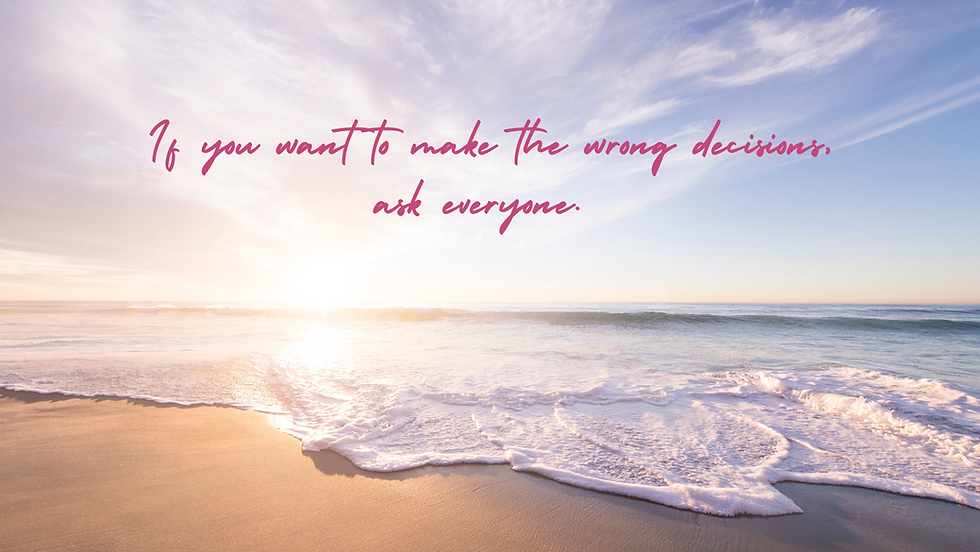
"If you want to make the wrong decisions, ask everyone."
I don't interpret that as a reason to stop seeking guidance.
I interpret it as a reminder that advice and authority are not the same thing.
I can listen to experts, respect their knowledge, ask difficult questions, and still remain an active participant in the decisions affecting my body.
Trusting myself doesn't mean assuming I know more than my doctors.
It means recognizing that my values, priorities, experiences, and quality of life deserve a place in the conversation.
It means being willing to change my mind when new information emerges.
It means knowing when to ask another question, seek another opinion, or reconsider something I once believed.
And perhaps most importantly, it means understanding that I don't have to defend every personal health decision to everyone who has an opinion about it.
Choosing Possibility Without Carrying the Blame
This may be the most important lesson I've learned.
For a long time, I felt an enormous responsibility to get everything right.
To research enough.
To make the right decisions.
To find the right practitioners.
To do all the things that might give my body the best possible chance.
And while I still believe in being proactive, I've come to recognize the danger of believing that the outcome rests entirely on my shoulders.
Because it doesn't.
Cancer is biologically complex. Treatment responses vary. There are factors we can influence and others we cannot control.
I can make thoughtful decisions, seek excellent care, support my physical and emotional well-being, and remain open to new information.
But I cannot personally guarantee the outcome.
And if something doesn't work, it doesn't mean I didn't try hard enough.
My responsibility is to make the most informed decisions I can with the information and resources available to me — not to control what cannot be controlled.
That realization hasn't diminished my hope.
It's made my hope a little more compassionate.
A little more sustainable.
And perhaps a little more grounded in reality.
A Note of Hope
If you're reading this while navigating your own diagnosis, uncertainty, or health challenge, I want you to know something.
You're allowed to ask questions.
You're allowed to seek additional perspectives.
You're allowed to explore approaches that complement your medical care, while remaining thoughtful about their evidence, safety, and potential interactions.
You're allowed to change direction.
You're allowed to decide that something no longer serves you.
And you're allowed to hold onto hope, even when the statistics feel overwhelming.
You don't have to choose between respecting science and believing in possibility.
You don't have to be endlessly positive to be resilient.
And you don't have to carry the responsibility for every outcome on your shoulders.
Your experience is uniquely yours.
Your decisions deserve to reflect your values, your circumstances, and the life you're trying to live.
As for me?
I'll continue asking questions. I'll continue learning. I'll continue considering possibilities, weighing evidence, and trusting myself to make thoughtful decisions along the way.
Not because I believe I can control everything.
But because I know the future isn't written in certainty.
Hope over inevitability. Not at the expense of science, but alongside it.
Every single time.
xo



Comments